

In late August my big Dioscorea elephantipes was a bare brown dome with an empty red trellis sticking out of it. Six weeks later the vine has climbed past the trellis and is reaching for the greenhouse window frame. Every one of my other Dioscoreas has woken up too: the young tubers in their trays and my single D. sylvatica.
Most of my other caudex plants are slowing down now, and the Pachypodiums are getting ready to drop leaves, while the Dioscoreas are just starting to grow.


In English you’ll see it called elephant’s foot or Hottentot bread. Older books list it as Testudinaria elephantipes. In Japan it’s 亀甲竜 (kikkōryū), “tortoise-shell dragon.” It’s worth searching the Japanese name. Japanese hobbyists have written month-by-month growing diaries for this plant in far more detail than anything I found in English, and much of what I do started with them.
My plants, and why it grows in winter
I bought my mature D. elephantipes years ago as a 5-year-old plant from a grower in France. It’s now about 8–9 years old, with a caudex 13 cm (5 in) across.
I also have one D. sylvatica and a lot of seedlings. There are 10+ at about two and a half years old, 25+ at a year and a half, and a younger batch sown around a year ago. About 50 more seeds went in a month ago and are coming up well.
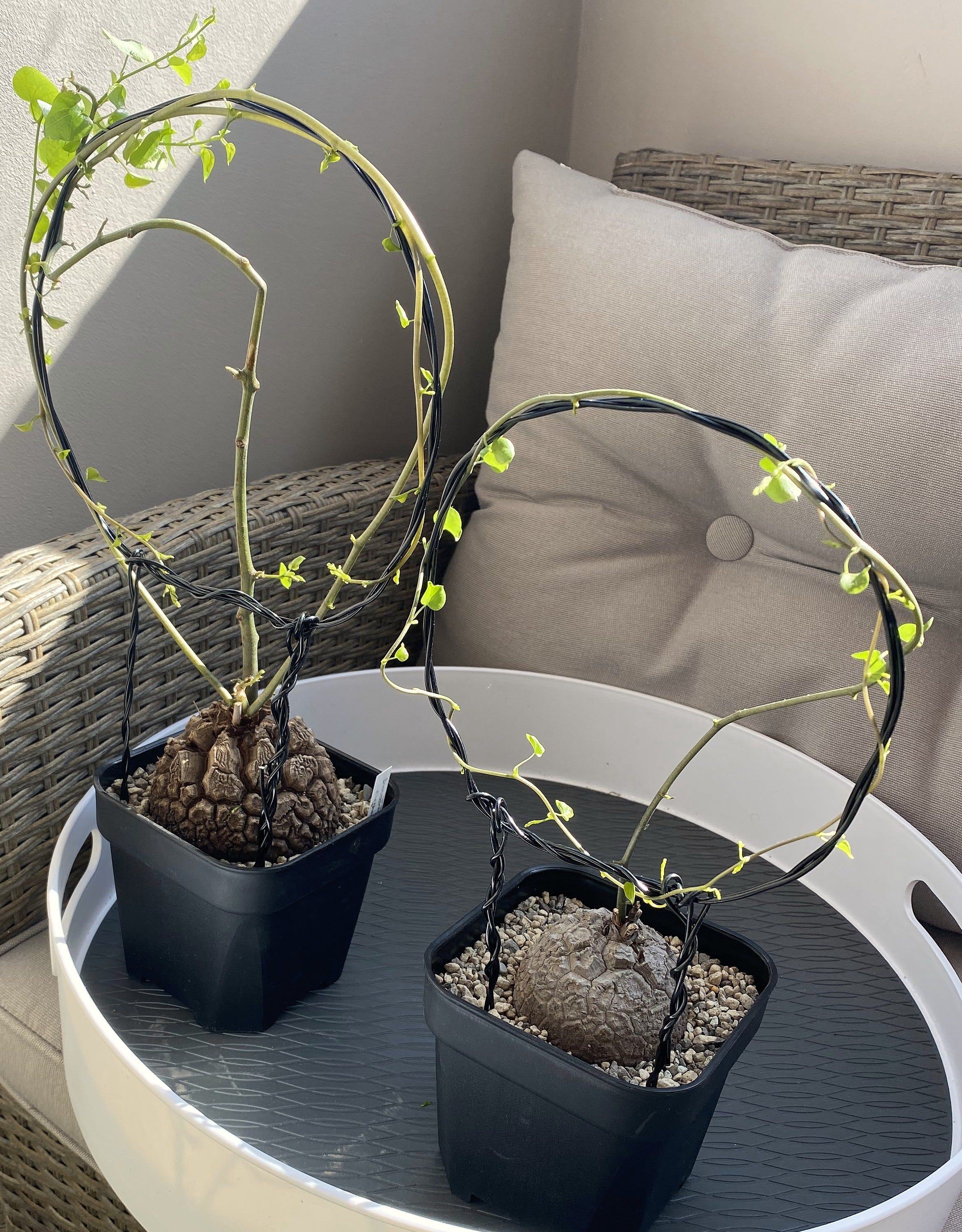
The oldest photo I have of my plants is from October 2023 on the glazed balcony: two young tubers, each with a thin vine twisting around a wire hoop. That’s where I learned what this plant wants. Everything is in the greenhouse now.
The main thing to know is that D. elephantipes is a winter grower. It comes from a winter-rainfall region, so it grows in the cool months and sleeps through the heat. Treat it like a Pachypodium and you’ll be watering it at exactly the wrong time of year.
My year with it looks like this:
May · I stop active watering. Leaves yellow, then the vine browns and dries.
Summer · It sleeps, and it’s just a caudex on gravel. I keep giving light surface watering, weekly or every two weeks. Seedlings get a bit more.
Late August to September · New shoots. This year the seedling tubers pushed shoots first, in early September. The mature plant followed a little later.
October to April · Growth, except for a pause in December and January. In the coldest weeks the vine just holds still. Through winter I water lightly every 2–3 weeks, always on a dry, sunny day.
A tip for new owners: you can count the age of an older plant. It sends up one new vine per year from the top of the caudex. If you buy a plant with old cut stubs on the crown, count them. One Japanese grower did this and worked out her plant was starting its fifth growing season.
Watering D. elephantipes through dormancy
Most care sheets say to stop watering completely in summer. I don’t quite do that. Some Japanese growers do exactly that, with no water from June to early September. They only cut off the dead vine in August, once the leaves come away with a gentle shake. The caution is understandable. One grower’s first plant was watered right after she bought it, went soft within two months, and when she pressed it the inside was mush.
Others are more nuanced. Older plants get no water, or a light misting once a month, in summer. But seedlings under two years old get water about every two weeks, ideally on a cool evening. Plants three or more years from sowing can handle a fully dry summer.
My greenhouse summers are very hot: around 35°C (95°F) during the day, big fan on most of the day. In that heat, a completely dry pot worried me more than rot did. So I do something in between and give just a little water on the surface. That keeps the fine roots alive, but the caudex never sits in wet mix.
A few small things helped me. I water around the caudex, near the pot rim, not over it. If you wet the tuber every time, a thin green film of algae can start growing on it. Once the vine is up in autumn the pot dries fast, so expect to water to drainage every 7–10 days or so.
In winter I only water in the morning, on a warm day, never in the evening. A pot that stays cold and wet overnight is how you lose plants. My balcony taught me that the hard way with Adeniums and Pachypodiums, not with Dioscorea.
And if you’re not sure whether a dormant plant is still alive, press the caudex gently. It should feel hard, like wood. Soft or spongy means rot, and more water won’t fix it.
Soil mix for Dioscorea elephantipes
Dioscorea wants a mix that drains well but isn’t bone dry. One point from the Japanese growers I hadn’t seen anywhere else: if drainage is too fast, the tuber swells more slowly. Young plants especially need some water and nutrient retention. This isn’t a cactus mix.
Mix 1 · Japanese style
Akadama 1 : pumice 1 : peat moss 1 (perlite can stand in for pumice)
At least three components. A single-ingredient mix ends up too extreme one way or the other.
Fine-to-small grains for seedlings in 6–9 cm (2½–3½ in) pots, small grains from 12 cm (5 in), medium grains above 15 cm (6 in).
From 12 cm (5 in) up, a layer of large pumice in the bottom.
Mix 2 · What I use
Perlite 40% Pumice 20% Peat 20% Coco coir 15% Humus 5%
Akadama is great, but for most people outside Japan it’s hard to find and expensive. Perlite, pumice and peat with a few additions does the same job well, and every component is available almost anywhere.
Pot size and planting depth:
A tuber of 1–2 cm (½–¾ in) goes in a 7.5 cm (3 in) pot. A tuber of 3–4 cm (1¼–1½ in) goes in a 9 cm (3½ in) pot. After that, leave about a finger’s width between caudex and pot wall, and go up roughly one size a year. Too big a pot holds water and rots roots.
Naturally about half the tuber sits below the soil. In one Japanese grower’s trial of 12 seedlings, shallow-planted ones developed deeper tortoise-shell cracks, while buried ones stayed smooth and pale. If you want the classic plates, raise the tuber a little each repot.
Feeding and pest care
Dioscorea puts on a lot of vine in a short season, and the tuber only grows if the vine is well fed. What I use:
Slow-release fertilizer in the mix: a cactus and succulent slow-release fertilizer (10-11-10), and more recently Magamp K, a slow-release granule popular with Japanese growers.
Liquid feed once a month during growth: a cactus and succulent liquid fertilizer (2-7-7). I stop for the two cold months, December and January, when the plants stall anyway. Seedlings benefit most. Mature plants need less.
Avoid organic fertilizers in a humid greenhouse. They encourage mold.
On pests and disease:
Seedling trays get Physan 20. Their soil stays constantly wet, which invites algae, and Physan keeps it in check.
Pesticide twice a year on the whole collection, in March and October. On Dioscorea, watch for aphids on new shoots, spider mites on the leaves, and scale on the caudex.
Repotting in dormancy (July–August)
I repot while the plant is dormant, in July or August, before the new shoot comes. A vine broken during repotting may not regrow that season. Japanese growers who tried spring repotting moved to late summer for this reason. By spring their roots had grown round and round the pots and were pushing out of the slits.
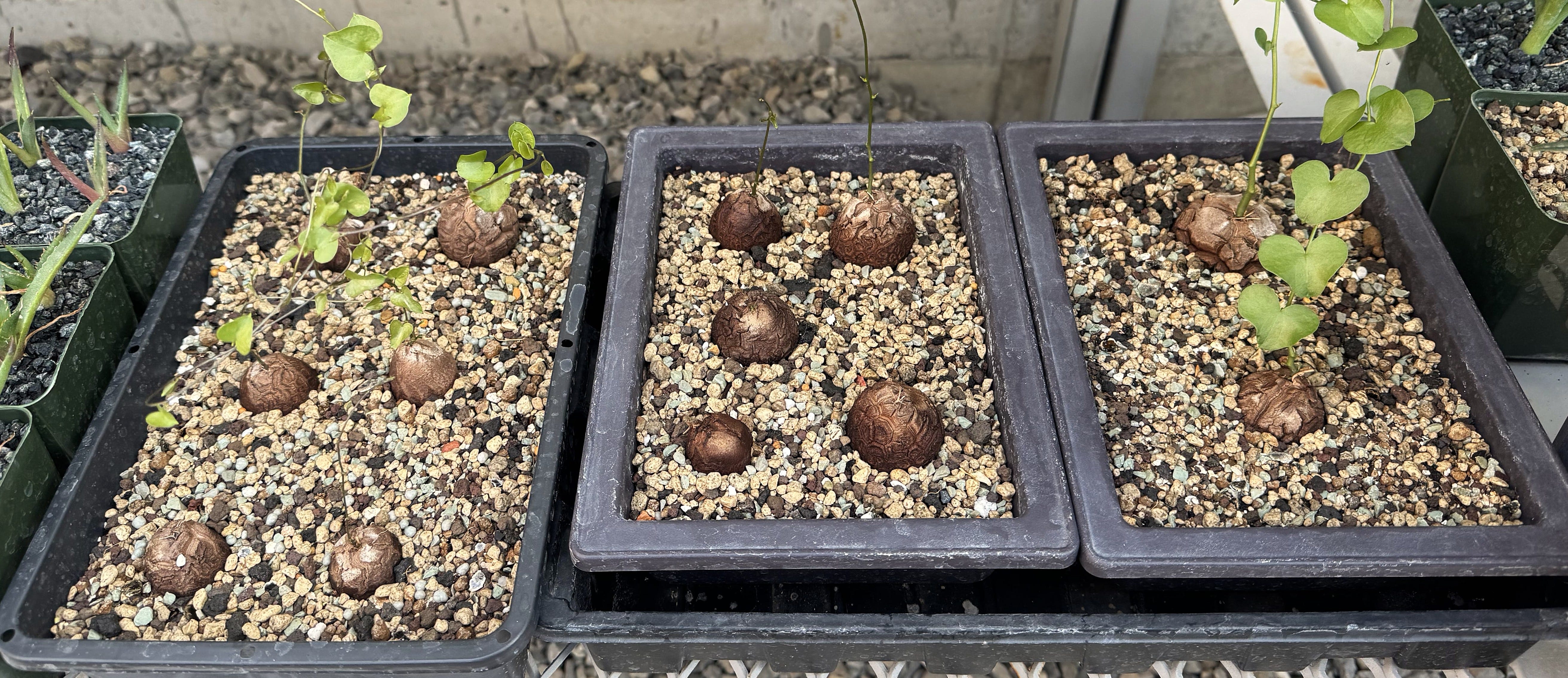
Seedlings grown one per pot make noticeably bigger tubers than ones sharing a pot. I didn’t do this well. I left mine sharing trays and round pots much longer than I should have, and you can see in the photo below how the vines end up tangled together. Next summer the 1.5-year-olds finally get their own pots.


Light, and looking after the vine
It doesn’t want blazing sun. Japanese growers use about 50% shade from April to September and full sun from October. Under strong spring sun, seedlings’ leaves can blacken, with dark veins showing. The caudex itself burns more easily than the leaves. A healthy vine covers it with leaves, so that’s another reason to let it grow.
I don’t use shade cloth. My greenhouse roof already cuts about 30% of the light, and where the plants sit there’s usually at least another 30% shading for much of the day. That has been enough. Under grow lights in winter, around 3,000 lux works. Leaves grey if the light is too close.
The tuber only grows if the vine does, so don’t damage it. One Japanese grower snapped a seedling’s stem moving a pot, and that plant fell clearly behind its siblings for the rest of the year. Another measured her vine at about 3.5 m (11½ ft), then snapped the main stem while re-winding it. So give it a trellis early, let it find its own way, and don’t untangle it later. That’s what the red trellis in my photos is for.


A few things worth buying if you’re starting out
Shallow rectangular bonsai-style pots for sowing. That’s what you see in most of my seedling photos. They give the tubers room and dry evenly. Ordinary 3-inch (7.5 cm) pots work fine too; I’ve sown in those as well. Once seedlings are big enough, move them on to one plant per pot.
A slow-release cactus fertilizer plus a low-nitrogen liquid feed. See the feeding section above.
Physan 20, or a similar algaecide, for seedling trays.
Fan. Still, cold, damp air is the enemy in winter, and moving air keeps a hot greenhouse bearable in summer.
Can D. elephantipes take cold? What my balcony showed
For several winters these plants lived on my closed, unheated, north-east-facing balcony. It sat mostly at 5–10°C (41–50°F), with a couple of weeks near 0°C (32°F) and about 60% humidity. That’s right in the middle of their growing season. Adeniums and several Pachypodiums didn’t survive those winters. I didn’t lose a single Dioscorea. They simply stalled in December and January, then picked up again as the days warmed.
That fits what Japanese growers report. A 5°C (41°F) minimum is recommended, and a few hours near 2°C (36°F) is survivable. Best growth comes between 10 and 20°C (50–68°F). Below about 10°C they hold still rather than die.
What’s next
This is the first winter these plants spend in the greenhouse, and the first time they’ll get heat during their growing season. A heater with a thermostat set to 8°C (46°F) goes in within the next 4–6 weeks, along with window insulation. I think the December–January stall might be shorter this year. I’ll photograph the mature plant and the 2.5-year-olds every month to see.
The new seedlings get their own post: Growing Dioscorea elephantipes from Seed. For why my thermostat is set to 8°C, see my post on minimum winter temperatures for cacti and caudex plants.


Further reading (Japanese): Dioscorea care guide · seed-sowing diary, month by month · one grower’s year with a mature plant